

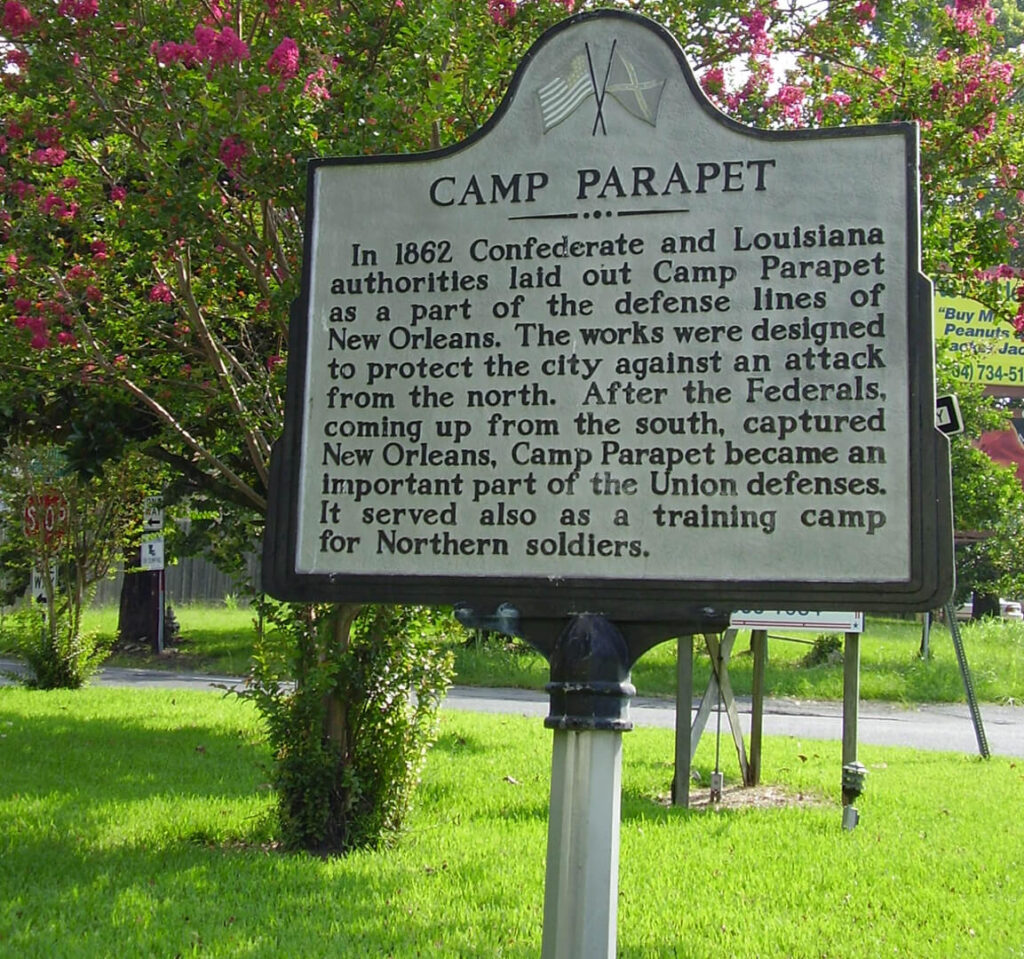
Camp Parapet Highway Marker
Significance:
- Confederate Origins (1861): Initially, the fortifications were built by the Confederacy in the summer of 1861 to defend New Orleans from a potential Union attack from the north (upriver). It was first known as Fort John Morgan, named after a Confederate colonel. The defenses consisted of a line of breastworks stretching about 1.75 miles from the Mississippi River north towards Metairie Ridge.
- Union Occupation and Expansion (1862-1865): After the Union capture of New Orleans in April 1862, Union forces occupied and significantly expanded the Confederate works. They renamed it Camp Parapet. Under Union control, it became a crucial part of the defenses against any Confederate attempts to retake the city.
- Military Complex: Camp Parapet evolved into a substantial military complex that included multiple fortifications (like the Main Redoubt and the Star Redoubt), adjacent campgrounds, a powder magazine, officer’s quarters, a guardhouse, and even a hot-shot furnace.
- Haven for Formerly Enslaved People: As the war progressed, Camp Parapet became a refuge for enslaved people who escaped to Union lines. These individuals, often referred to as “contrabands,” were employed in various capacities, including the construction and repair of fortifications and infrastructure.
- Early Recruitment of Black Troops: Notably, Camp Parapet was one of the early sites where African American men were recruited and trained to fight for the Union Army. Some of the first United States Colored Troops (USCT) units were formed here.
- No Direct Combat: Interestingly, despite its significance as a defensive position and training camp, Camp Parapet never saw direct combat during the Civil War.
- Post-War Use and Legacy: After the war ended in 1865, the fortifications were abandoned. For a period in the late 19th and early 20th centuries, the powder magazine of the former Fort John Morgan served as the Jefferson Parish East Bank Jail.
- Remaining Structure: Today, the powder magazine is the only surviving structure of the extensive Camp Parapet fortifications. It is preserved in a small park on Arlington Street, near Causeway Boulevard, and is listed on the National Register of Historic Places.
- Historical Markers: While the earthworks are gone, historical markers in the area, including this one at Jefferson Highway and Causeway Blvd, serve to remind people of the site’s important role in the Civil War and its impact on the region.
Camp Parapet represents a key location during the Civil War in the defense of New Orleans, the transition of power from Confederate to Union control in the region, and the early involvement of African Americans in the Union Army. The remaining powder magazine stands as a tangible link to this significant period in American history.After the Union capture of New Orleans in 1862, they occupied and expanded the fortifications, renaming it Camp Parapet. It then served as a significant part of the Union defenses against a possible Confederate counterattack and also became a training camp for Union soldiers, including some of the first United States Colored Troops.
All that remains of the original Camp Parapet is the powder magazine, which is located a short distance away on Arlington Street and is listed on the National Register of Historic Places. The fortifications themselves extended from the Mississippi River north towards Lake Pontchartrain.